How a Lack of Fiber Harms the Gut
Dietary fiber—or at least some types of it—feeds the bacteria in the human gut. This strengthens the bacteria that are important for human health. But what happens when dietary fiber is lacking? When the bacteria in the gut run out of food? Then some of them look for a new food source—and eat the gut’s protective mucus layer.
The German Nutrition Society recommends at least 30 grams of dietary fiber per day. This recommendation was supported in 2019 by a large meta-analysis that synthesized the results of many studies. The analysis showed that a daily dietary fiber intake of more than 25 grams was associated with a lower risk of mortality. In addition, these individuals were less likely to develop coronary heart disease, stroke, type 2 diabetes, and colorectal cancer. Fiber therefore appears to play an important role in human health.
Why is dietary fiber so important?
The human body can utilize dietary fiber only to a very limited extent, if at all. As a result, it reaches the large intestine largely undigested, where the majority of bacteria live. Not all dietary fiber is processed the same way there: Some is fermented by bacteria and thus serves as food for them, while other types can be broken down only to a very limited extent, if at all . Non-fermentable dietary fiber primarily supports bowel motility and influences the speed at which food passes through the intestines. Fermentable dietary fiber is particularly important for the microbiome.
The bacteria in the gut have special enzymes—a sort of toolbox—that allow them to break down carbohydrates, including dietary fiber, and use them as food. The human body has just 17 enzymes for this purpose, whereas the microbiome has a huge “toolbox” with over 1,000 enzymes. When certain types of dietary fiber are broken down, substances are produced that in turn serve as food for other bacteria. This sharing of food is called cross-feeding: a single type of dietary fiber can thus feed a wide variety of bacterial species.
On average, however, women in Germany consume just 18 grams per day, and men 19 grams—significantly less than the recommended 30 grams. This means that most of the bacteria in the gut are constantly starving.

What happens when you don't get enough fiber?
First things first: Starvation can actually cause some of these bacterial species to disappear. The diversity of the gut microbiome decreases.
But it is precisely this diversity that is important, as it makes the microbiome more resilient. If a disruption occurs—for example, due to the taking an antibiotic, a previously diverse microbiome can often recover more effectively.
Without enough fiber, gut bacteria also produce fewer metabolic byproducts. These include short-chain fatty acids. These play key roles in the body. In particular, butyrate serves as an important energy source for the cells of the intestinal mucosa. In addition, short-chain fatty acids can have anti-inflammatory effects and even influence which genes are active in the body’s cells.
Without dietary fiber, the number of beneficial bacteria decreases, as do the metabolic byproducts they produce, which are important for a healthy body.
But that's not all: Not all bacteria can simply be starved out. Some switch to alternative food sources— at the expense of humans.
The Intestinal Protective Layer
The human intestine is lined with a mucous membrane that produces 10 L of mucus daily. This mucus forms a layer in the intestine, also known as the mucus layer. It performs important functions. One of them is that it acts as a kind of protective shield for the intestine. Like a moat, it keeps bacteria confined to the intestinal lumen—that is, inside the intestine—and away from the intestinal wall and the blood vessels behind it.
The microbiome is important for human health, but only as long as it remains in balance. This means that the majority of bacteria remain in the large intestine and do not enter other parts of the body. To ensure this, the mucus layer there is divided into two layers. The dense inner layer, which acts like a moat, lies directly on the surface of the intestinal cells and is largely free of bacteria under normal conditions. The outer layer is looser and serves as a habitat for the gut bacteria, providing nourishment for some of them. Although the mucus layer consists mainly of water, its most important component is the mucin protein MUC2, to which numerous sugar chains are bound. These sugar chains serve as food for many gut bacteria.
When the balance is healthy, the mucus layer performs two important functions: It provides a habitat and nourishment for the gut microbiome and protects the body by preventing bacteria from leaving the gut and entering other parts of the body.
When the Balance Is Upset
This delicate balance is disrupted when there is a lack of dietary fiber. The microbial Garden of Eden turns into a battlefield for nutrients. Those who can adapt best now have the advantage. In this case, there are two main groups.
The Mucus Specialists
The first group includes bacteria that feed on components of the intestinal mucus, such as Akkermansia muciniphila. While their competitors in the gut run out of nutrients, their food source remains available to them. This gives them a competitive advantage.
The All-Around Talents
In addition to the “mucus specialists,” flexible bacterial species also benefit. They are the all-arounders among gut bacteria: not picky, but equipped with a variety of enzymes to break down different food sources. If dietary fiber is lacking, some of them can switch gears and feed on the sugar chains in the human mucus layer as well.
Under these conditions, these two groups can multiply more rapidly. As a result, the mucus layer is increasingly used as a food source. It becomes thinner —and the intestine’s protective barrier weakens.
What does science say?
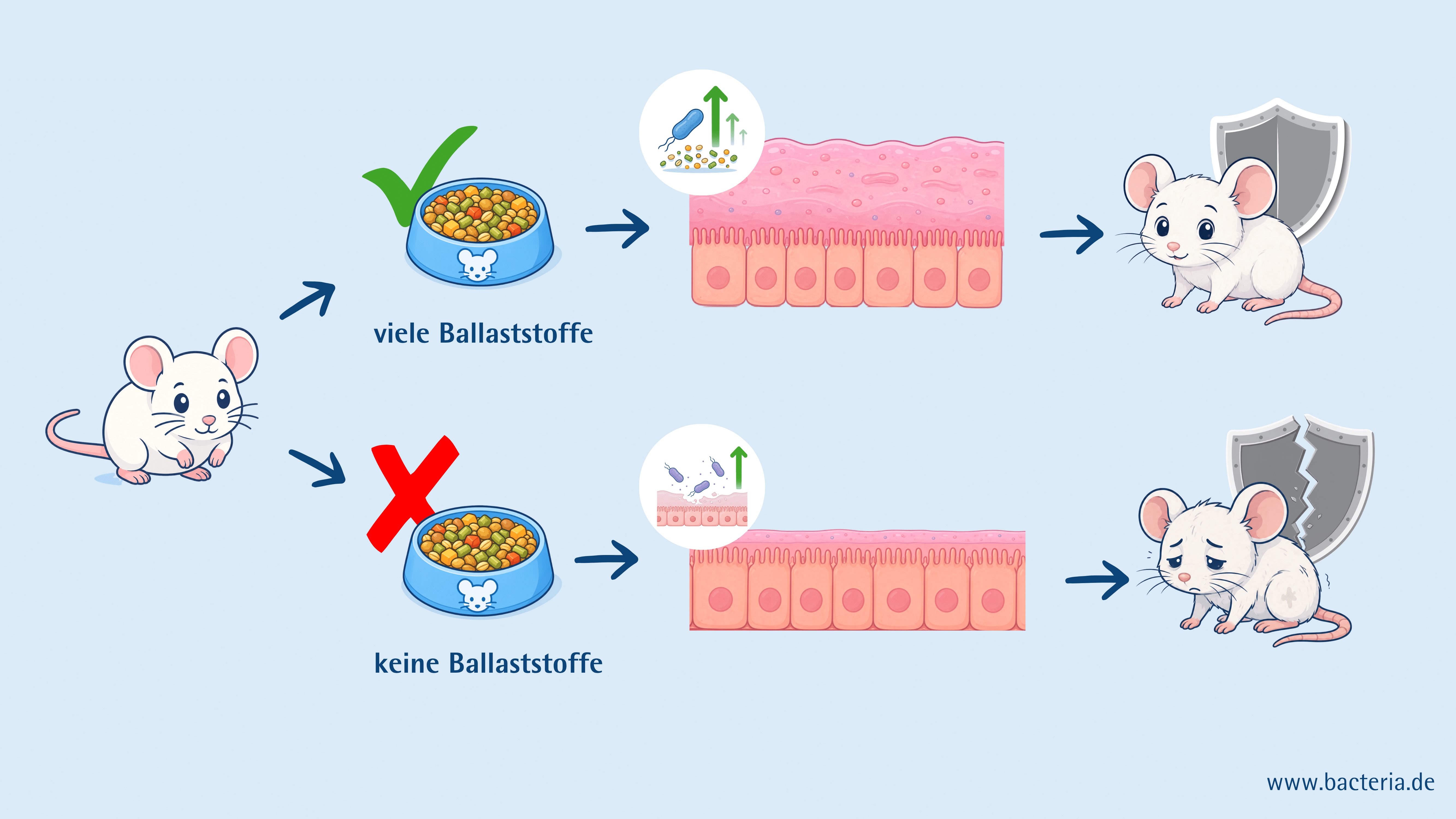
An impressive mouse study from 2016 demonstrated how a diet lacking in dietary fiber can affect the mucus layer. The researchers colonized germ-free mice—that is, mice without their own microbiome—with 14 bacterial species that are also found in the human gut. After these bacteria had established themselves in the gut, the mice were fed different diets:
- a high-fiber diet
- a diet low in fiber
- alternating between the two diets on a daily or four-day basis
By switching between the different diets, the researchers sought to replicate the daily fluctuations in the human diet.
Depending on the diet, different types of bacteria increased in number—namely, those that could utilize the nutrients available in each case. With a high-fiber diet, bacteria capable of breaking down fiber were particularly more common. In the fiber-free group, on the other hand, bacteria that can break down components of the intestinal mucus increased in number. Some flexible bacterial species, which can utilize both fiber and intestinal mucus, also shifted their metabolism and began breaking down intestinal mucus more intensively. When the diet was varied, the composition of the microbiome quickly adapted to the respective food.
But it wasn’t just the bacterial composition that changed as dietary fiber intake decreased. As expected, the mucus layer in the large intestine also became thinner. This was particularly evident in mice that received no dietary fiber at all. But the mucus layer was also thinner in mice that alternated between a high-fiber and a fiber-free diet.
But the scientists didn't want to stop there. They wanted to find out what a thinner mucus layer meant for the mice's health. To do so, they infected the mice—some fed a high-fiber diet and others a fiber-free diet—with Citrobacter rodentium, a pathogen known to affect mice.
While all the mice in the high-fiber group survived, the condition of the animals in the fiber-free group deteriorated so severely that 60 percent of them had to be euthanized after ten days to prevent undue suffering.
What can be applied to people
But the experiment was conducted on mice and under extreme conditions. So to what extent can the results be applied to humans? The key difficulty is that the thickness of the mucus layer in mice could only be measured under a microscope after the large intestine had been removed. For obvious reasons, this is much more difficult in humans.
Nevertheless, there are indications that similar mechanisms play a role in humans.
- The mice were given a humanized microbiome. This means that the 14 bacterial species used are also found in the human gut.
- The intestinal mucosa of mice and humans has a similar structure.
- A study of healthy adults examined the microbiome’s genetic toolkit. The greater the proportion of genes involved in breaking down components of intestinal mucus relative to genes involved in breaking down plant fiber, the higher the levels of inflammatory markers in the gut.
- A permeable mucus layer can also cause inflammation in the intestines in humans.
But the most important difference remains: In the mouse study, only 14 bacterial species were examined . Although the scientists had previously tested them to see if they could break down dietary fiber and/or components of the intestinal mucus, a real human microbiome is significantly more complex and comprises several hundred bacterial species.
Protein Instead of Fiber?
But not all types of bacteria take refuge in the intestinal mucus. Some also benefit from a diet that’s currently in vogue: high in protein and often low in carbohydrates. If you look around the supermarket, almost every food item is now available in a “high-protein” version. That might sound good at first—after all, proteins are among the most important building blocks of the human body. However, a high-protein diet often goes hand in hand with fewer carbohydrates and, consequently, less dietary fiber.
But if the bacteria can feed on the proteins that reach the large intestine undigested, that's not a problem—is it?
As early as 2011, a study involving 17 overweight men examined how this diet affects metabolic byproducts in the gut. The researchers found increased levels of substances produced during bacterial protein fermentation, including, for example, N-nitroso compounds. Not all of these substances are toxic in and of themselves. However, they are associated with rather unfavorable consequences for gut health. At the same time, levels of butyrate and other substances—which are produced from plant-based dietary fiber and are considered to have a protective effect on the gut—decreased.
Unlike the breakdown of dietary fiber, the breakdown of proteins by gut bacteria can therefore lead to the increased production of substances that are potentially harmful to the human body.

The microbiome is both fascinating and complex because it’s rarely possible to say definitively whether something is always good or always bad. This also applies to protein fermentation. A good example is the amino acid tryptophan.
When tryptophan reaches the large intestine, various bacteria can process it in different ways.
Some of these compounds can support health. These include, for example, indole-3-lactic acid (ILA) and indole-3-propionic acid (IPA). ILA can help prevent the immune system from overreacting to harmless components of food. IPA, in turn, can help maintain the mucosal barrier in the gut.
However, substances that are associated with health risks can also be produced. One example is indole. It is metabolized in the liver into indoxyl sulfate, which can play a role in chronic kidney disease.
But what determines which substances are actually produced? This is where the circle closes: Which bacteria process tryptophan and how is no coincidence. It depends, among other things, on how much dietary fiber reaches the gut. The bacterial breakdown of dietary fiber produces simple sugars. In some bacteria, these can inhibit the conversion of tryptophan to indole. As a result, less of the potentially harmful indole is produced. At the same time, more tryptophan remains available for the formation of ILA and IPA. This is yet another example of how a lack of dietary fiber in the gut can have consequences that aren’t immediately obvious.
It’s not just a matter of what health benefits dietary fiber provides when it’s present. At least as important is what happens when it’s lacking. Because then, the delicate balance between humans and microbes can be thrown off. Fiber is therefore not just a “nice bonus,” but an essential requirement for maintaining this balance.
List of Sources and Further Reading
Blecksmith, Sarah E., Andrew Oliver, Zeynep Alkan, and Danielle G. Lemay. “Gut Microbiome Genes Involved in Plant and Mucin Breakdown Correlate with Diet and Gastrointestinal Inflammation in Healthy U.S. Adults.” The Journal of Nutrition 155, no. 11 (2025): 3757–68. https://doi.org/10.1016/j.tjnut.2025.08.027.
Desai, Mahesh S., Anna M. Seekatz, Nicole M. Koropatkin, et al. “A Dietary Fiber-Deprived Gut Microbiota Degrades the Colonic Mucus Barrier and Enhances Pathogen Susceptibility.” Cell 167, No. 5 (2016): 1339–1353.e21. https://doi.org/10.1016/j.cell.2016.10.043.
Johansson, Malin E. V., Jenny K. Gustafsson, Jessica Holmén-Larsson, et al. “Bacteria Penetrate the Normally Impenetrable Inner Colon Mucus Layer in Both Murine Colitis Models and Patients with Ulcerative Colitis.” Gut 63, No. 2 (2014): 281–91. https://doi.org/10.1136/gutjnl-2012-303207.
Reynolds, Andrew, Jim Mann, John Cummings, Nicola Winter, Evelyn Mete, and Lisa Te Morenga. “Carbohydrate Quality and Human Health: A Series of Systematic Reviews and Meta-Analyses.” The Lancet 393, No. 10170 (2019): 434–45. https://doi.org/10.1016/S0140-6736(18)31809-9.
Russell, Wendy R., Silvia W. Gratz, Sylvia H. Duncan, et al. “High-Protein, Reduced-Carbohydrate Weight-Loss Diets Promote Metabolite Profiles Likely to Be Detrimental to Colonic Health.” The American Journal of Clinical Nutrition 93, No. 5 (2011): 1062–72. https://doi.org/10.3945/ajcn.110.002188.
Sinha, Anurag K., Martin F. Laursen, Julius E. Brinck, et al. “Dietary Fiber Directs Microbial Tryptophan Metabolism via Metabolic Interactions in the Gut Microbiota.” *Nature Microbiology* 9, No. 8 (2024): 1964–78. https://doi.org/10.1038/s41564-024-01737-3.
Song, Chunyan, Zhenglong Chai, Si Chen, Hui Zhang, Xiaohong Zhang, and Yuping Zhou. “Intestinal Mucus Components and Secretion Mechanisms: What We Do and Do Not Know.” Experimental & Molecular Medicine 55, No. 4 (2023): 681–91. https://doi.org/10.1038/s12276-023-00960-y.