Live Online Seminar
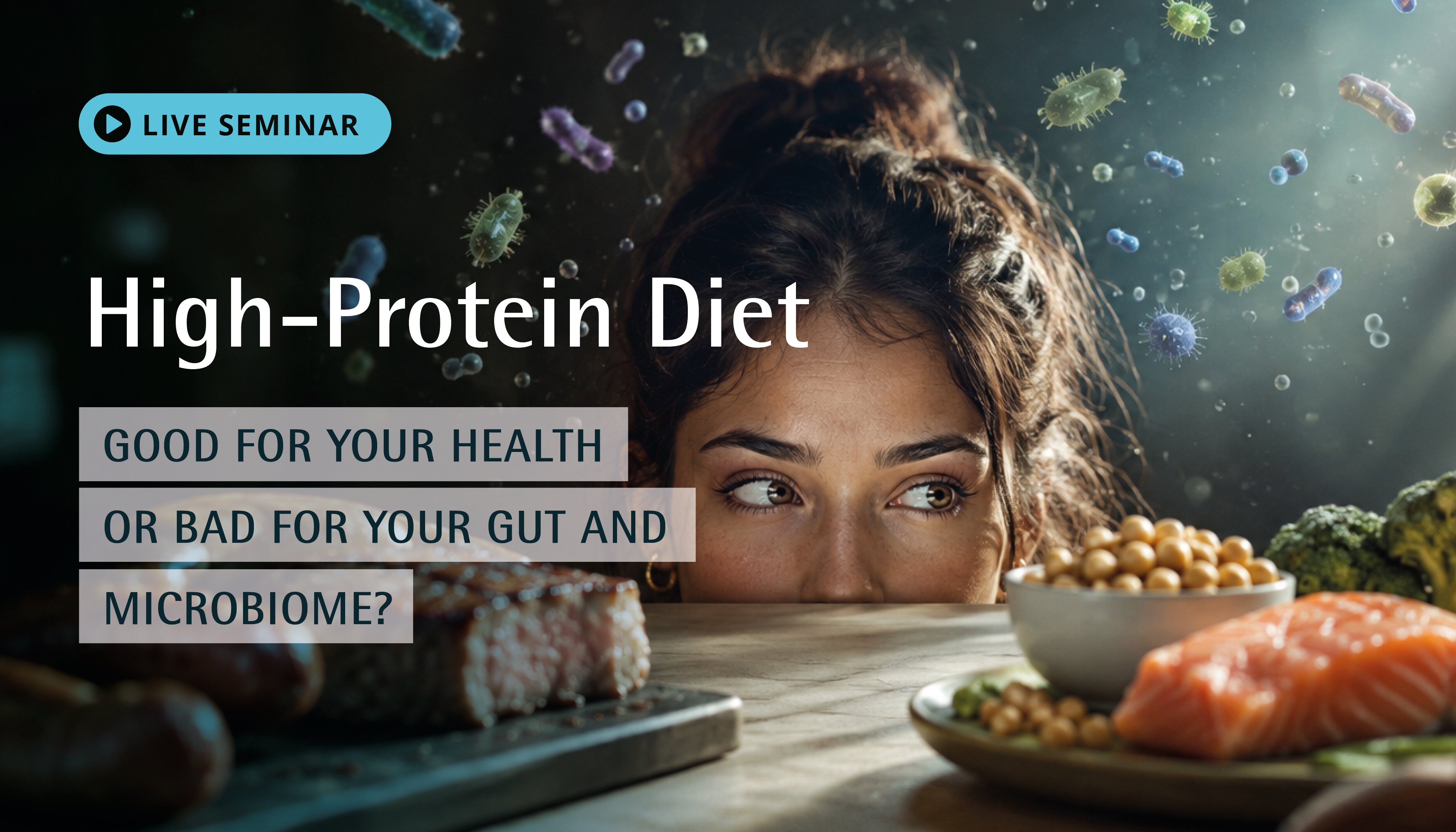
A High-Protein Diet: Good for Your Health or Bad for Your Gut and Microbiome?
In our article, we cover the basics of a gut- and microbiome-friendly, high-protein diet. In our live online seminar, however, we take it a crucial step further. Here, you’ll learn in detail not only the theory—including an overview of the relevant scientific studies—but also how to put it into practice in your daily life: What does a sensible, high-protein diet look like?
An essential seminar if you want to tailor your high-protein diet to your individual needs without harming your gut and microbiome.
Non-binding registration on the waiting list
Sign up and you'll be the first to know when registration for the seminar opens.
That is exactly what this seminar is about
We will take a close look at what is actually known scientifically, where the evidence is clear, and where it extends far beyond what many claims on social media or on product packaging would suggest.
This involves, in particular, the following questions:
How much protein do people really need?
How should general recommendations be interpreted?
When might a higher protein intake be beneficial?
And does it make a difference whether someone is 25, 45, or 70 years old, does strength training, wants to lose weight, or is simply following a current diet trend?
What happens to protein after a meal?
We track the ingested protein as it moves through the digestive tract.
How is it taken apart?
How much is absorbed?
What factors affect digestibility?
And under what conditions do more protein and amino acids reach the large intestine?
And: Why is that important in the first place?
What does the gut microbiome make of this?
A very interesting part of the story begins in the large intestine—a topic that is surprisingly rarely discussed in the context of high-protein diets.
We study the microbial utilization of proteins and amino acids and the metabolic products that may be produced in the process.
In doing so, we will also take a close look at why the simple distinction between “good” and “bad” gut bacteria is not very helpful, and why the function of a microbial ecosystem is often more interesting than the mere presence of individual bacteria.
Animal or plant-based protein?
Is plant-based protein automatically better for your gut?
Is animal protein inherently problematic?
Or do even these simple comparisons fall short once again?
We examine differences in amino acid composition, digestibility, and food matrix, and, above all, the question of which other components are consumed along with a protein source.
After all, a legume isn't just made up of protein. Neither is a piece of meat.
What should we think of protein powders?
Protein powders can be a very convenient way to increase your protein intake.
But which product is a good choice for a high-protein diet?
Whey protein, casein, soy, peas, or blends of various plant-based proteins?
Which differences are actually relevant, and which ones play a much smaller role in everyday life than advertising suggests?
We'll also take a closer look at additives, sweeteners, and the question of what a protein shake replaces in the rest of your diet.
What about the high-protein trend?
These days, there’s hardly a food item left that isn’t also available in a high-protein version.
But a high protein content alone does not make a product a good food.
We'll take a look at when high-protein products can actually be useful and when the protein is primarily part of a marketing strategy.
The crucial question is not:
"Does this product have a lot of protein?"
Rather:
"Does this food fit into an overall well-balanced diet?"
How does fiber work?
It is not possible to make a meaningful assessment of a high-protein diet by looking solely at protein intake.
It is at least as interesting to consider what people eat at the same time and what they might be eating less of.
Dietary fiber provides gut bacteria with substrates other than proteins. As a result, it influences which microbial metabolic pathways are preferentially activated.
That is why we will discuss in detail the role that vegetables, legumes, whole grains, resistant starch, and other high-fiber foods can play in a high-protein diet.
Eating a high-protein diet doesn't just mean focusing on protein.
Lecturer:
Event details:
Date: TBD; weekend
Time: Saturday and Sunday: 10:00 a.m. – 12:00 p.m. each day
Duration: 4 hours
Format: Live online seminar; interactive with the opportunity to ask questions
Cost: 99 EUR when booking as a person on the waiting list; 129 EUR for a regular booking
Language: English
What you'll be better able to assess after the seminar
After the seminar, you’ll be much better able to assess the big picture and adopt a conscious, protein-rich diet that’s gut- and microbiome-friendly. You’ll be able to spot the misinformation that’s often found online and evaluate information reliably.
Among other things, you'll be better able to assess:
- How Much Protein Might Be Best for Your Goal
- When Does Eating More Protein Actually Offer a Benefit?
- What differences between various protein sources are relevant?
- how protein is processed in the digestive tract
- What "proteolytic fermentation" means
- which is why their metabolic byproducts must be considered separately
- how protein powders should be classified
- When high-protein products are a good idea—and when they're not
- Why Fiber Plays a Key Role in a High-Protein Diet
- how to make meals high in protein without losing sight of the rest of your diet
Our goal is not to tell you what to eat.
Our goal is to provide you with enough knowledge so that you can make such decisions on a more informed basis.
Here's how the live online seminar is scheduled
The seminar will take place entirely live via Zoom .
The plan is to hold two sessions, each lasting about two hours, over the course of a weekend.
Part 1: Understanding
In the first part, we’ll explore the biological and scientific foundations of a high-protein diet and its effects on the gut and the microbiome:
In doing so, we’ll take a closer look at the following, among other things:
- Protein Requirements
- Muscle Building and Muscle Maintenance
- Digestion and Absorption
- Protein in the Large Intestine
- Intestinal microbiome
- proteolytic fermentation
- microbial metabolites
- Scientific Evidence and Its Limitations
Part 2: Implementation
The second part focuses more on practical nutrition.
Among other things, to:
- animal and plant-based protein sources
- Protein Powder
- High-Protein Products
- Dietary fiber
- Food Combinations
- Practical Meal Strategies
- specific examples from everyday life
Non-binding registration on the waiting list
Sign up and you'll be the first to know when registration for the seminar opens.
Who is this seminar intended for?
This seminar might be of interest to you if you:
- You already eat a diet that's high in protein
- You want to increase your protein intake
- You do strength training
- want to build muscle
- want to maintain as much muscle mass as possible as you get older
- pay closer attention to protein intake while losing weight
- Do you use protein shakes or protein powder?
- buy high-protein products regularly
- You're interested in the gut and the microbiome
- want to better understand the conflicting statements about high-protein diets
You don't need any special scientific background to do this.
Who is this seminar NOT intended for?
This seminar probably isn't the right format for you if you're expecting a simple list of allowed and forbidden foods.
You won't hear us making sweeping statements like "a lot of protein is healthy" or "a lot of protein is bad for your gut," either.
And if you're mainly looking for quick microbiome hacks or spectacular health claims, you probably won't find what you're looking for here either.
We're interested in a different question:
What do we actually know, and what reasonable conclusions can we draw from this?
Scientific precision instead of simple answers
Nutrition science and microbiome research are complex.
That doesn't mean you can't make practical decisions based on it.
But it does mean that you have to take a closer look.
In our seminar, we distinguish between:
What is well documented
Results that can be interpreted with relative reliability based on controlled human studies and a consistent body of scientific data.
What is likely
Biological relationships for which there is strong evidence, but whose significance in humans has not yet been conclusively established.
What is, for now, primarily a hypothesis
Mechanisms, animal studies, or observations that raise interesting questions but do not yet yield reliable practical recommendations.
This distinction is often blurred, especially when it comes to the microbiome.
At My Bacteria, we don't do that.
Insights, not promises.
Frequently Asked Questions
Is enrollment on the waiting list binding?
No. The waiting list is strictly a non-binding reservation. You won't decide whether you actually want to sign up for the seminar until the date is announced.
When will the seminar take place?
We are currently planning a weekend in the fourth quarter of 2026. The exact date has yet to be determined.
How much does the seminar cost?
99 EUR if you were on the waiting list. 129 EUR for a regular booking if you weren't on the waiting list.
How can I sign up for the seminar?
As soon as registration for the seminar opens, you'll have the opportunity to make your reservation—provided you've signed up for the waiting list.
How will the seminar be conducted?
The seminar will take place live via Zoom over the course of a weekend. Two sessions are planned (one on Saturday and one on Sunday), each lasting about two hours. Both sessions begin at 10:00 a.m.
In what language will the seminar be held?
The language of instruction is English. However, there is also a seminar taught in German. In that seminar, the language of instruction is English.
Can I ask questions during the seminar?
Yes. That is precisely why the seminar is being held live. In addition to the prepared material, there will be plenty of time for questions and discussion.
Do I need prior knowledge of science?
No. We will explain the biological and nutritional concepts in a way that is easy to understand. For us, scientific accuracy does not mean using as many technical terms as possible.
Non-binding registration on the waiting list
Sign up and you'll be the first to know when registration for the seminar opens.
Do you have any more questions?
Please contact us, and we'll be happy to answer your questions.