Can a fecal microbiota transplant change a person's personality?
A patient with a severe Clostridioides difficile infection, in whom antibiotic treatments have repeatedly failed, receives a fecal microbiota transplant (FMT). In this procedure, a portion of a human donor’s gut microbiome is transferred to the recipient. The infection is cured, but the man gradually notices a subtle change in his character. Has the procedure actually changed him? Has his personality changed? Is he still the same person?
The book "Alter Ego" which was published at the end of July at Piper Verlag tackles precisely this topic in a literary way. The protagonist, Simon, suffers from a severe Clostridioides difficile infection that doctors are unable to bring under control, even after multiple courses of antibiotics. As a last resort, he receives a fecal microbiota transplant (FMT), also known as a stool transplant, which cures him within a few days. But the procedure seems to come at a price. Simon’s personality changes noticeably.
But how realistic is such a change? Does it stand up to critical scientific scrutiny? And what do animal and human studies say about it?
Fecal microbiota transplants are well-established
In Germany and the United States, fecal microbiota transplantation—commonly referred to as a “stool transplant”—has now become an established procedure, particularly for recurrent C. difficile infections. In this procedure, processed and thoroughly tested donor material is transferred to the recipient. However, conventional FMT is not approved as a standard medical treatment and is therefore used only under certain conditions or as part of clinical trials.
The medication can be administered via capsules or directly into the intestine. With the rectal route of administration, the fecal suspension is administered, for example, via an enema or introduced into the large intestine via colonoscopy. The latter method is particularly advantageous because the suspension can be distributed overlarger areas of the large intestine; however, it also places a greater burden on the patient.
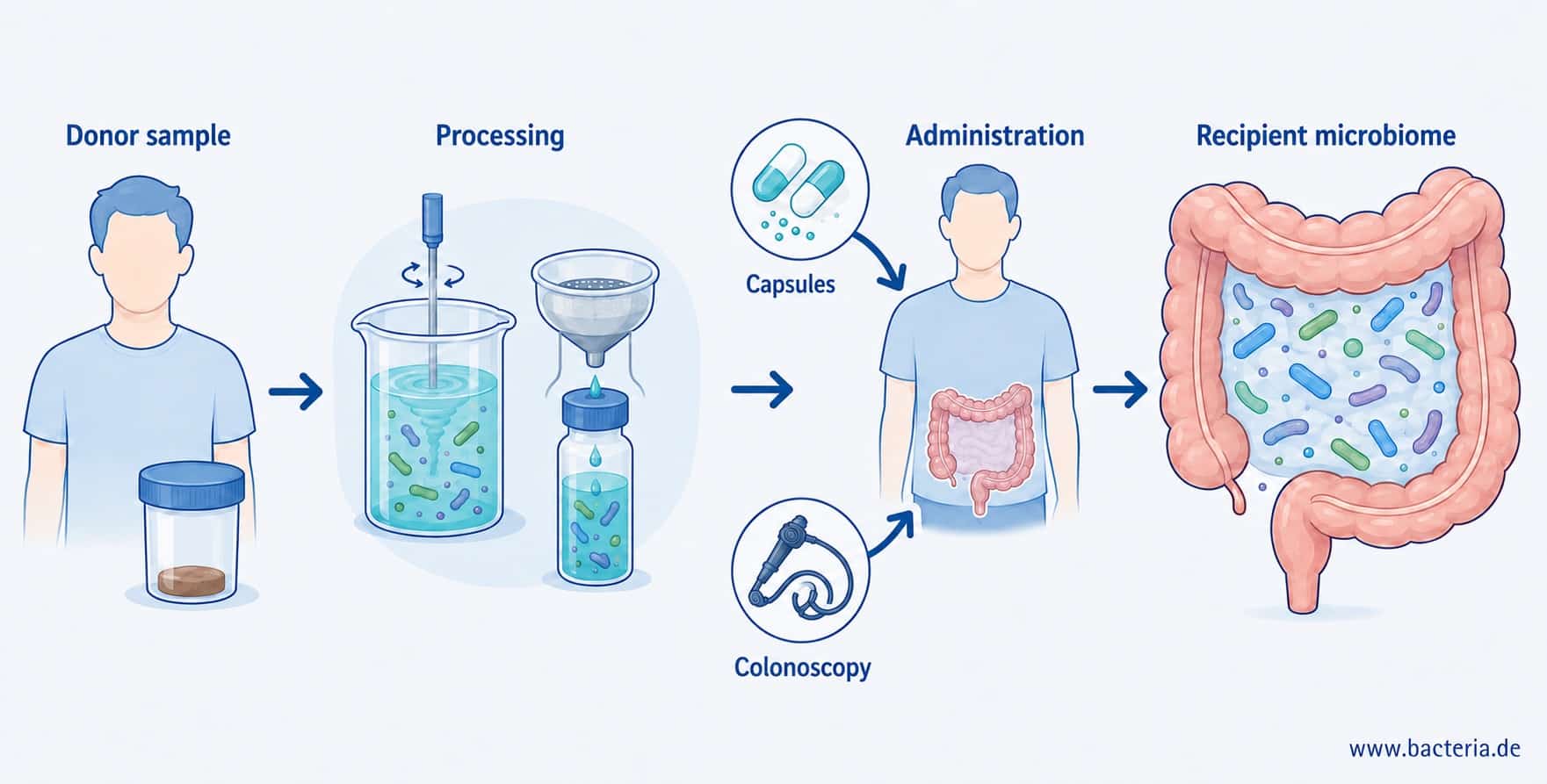
There is one notable exception in the U.S.: Two standardized microbiota products derived from human stool have already been approved by the FDA: REBYOTA, a rectally administered suspension, and VOWST, which is taken orally in capsule form. Neither is approved for the treatment of an acute infection, but rather for the prevention of recurrence following antibiotic therapy.
The Story of Simon
We do not intend to summarize the novel here. It is a gripping read, and we do not want to spoil it. Nevertheless, we can briefly summarize the key points relevant to our question.
As described above, the protagonist, Simon, receives a stool transplant—a so-called fecal microbiota transplant—to treat his C. difficile infection. The treatment is successful, and Simon is captivated by the idea of the holobiont: the symbiosis between human cells and the associated microorganisms.

He is becoming increasingly enthusiastic about microbiology and is sharing more and more details about the holobionic concept and the uniqueness of microorganisms. But his personality is gradually changing. He is becoming more animalistic, aggressive, and combative. At night, he roams through parks and neighborhoods, not even shying away from break-ins and fights. In his mind, the foreign microbiome is gradually taking control of him, and he wonders how he can bring this threat under control.
The book is written in an engaging style and offers an unusual perspective on microbiology from a fictional standpoint.
Throughout the story, the author consistently avoids the obvious literary exaggeration. Simon does not turn into the Hulk or Frankenstein's monster; rather, his protagonist undergoes changes that are, at the very least, within the realm of possibility.
It is precisely this subtlety and restraint that make this book so compelling, because they leave room for the crucial question: Is that really possible?
Short Biography
Benedikt Gollhardt, born in 1966, is a screenwriter for award-winning TV series and films. His first novel stormed the SPIEGEL bestseller list and won the Wittwer-Thalia Debut Crime Novel Prize. The author lives with his family in Cologne.
The Experiment Behind "Alter Ego": Siberian Hamsters
The challenge with experiments involving microbiomes is always the same question: Is the change in the microbiome a consequence of the observed change—such as behavior, disease, or increased fitness—or was the microbiome the direct cause of it?
An American research team at the University of Memphis set out to resolve this dilemma, known asthe “cause or effect”dilemma. To this end, they conducted experiments with male Siberian hamsters. These animals exhibit a striking behavior: In winter, with its short periods of daylight, they are significantly more aggressive than in summer, with its long periods of daylight. It was already known that this change in behavior was also accompanied by a change in their microbiome. But was this the cause or merely the effect of the different light conditions?
To investigate this, the researchers exposed the hamsters to different light conditions. As expected, the short-day hamsters exhibited increased aggression, and their microbiome also changed.
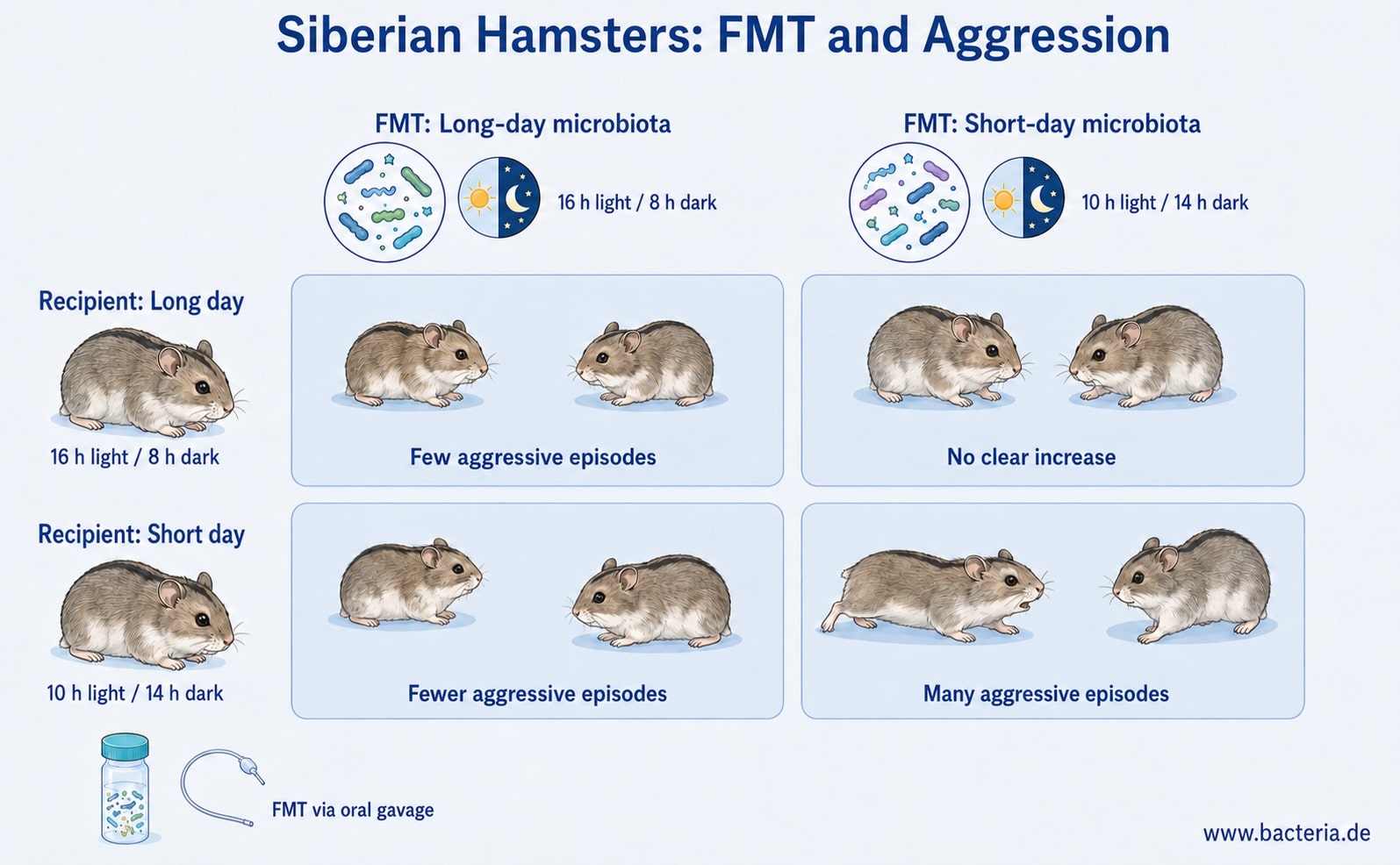
But the researchers took it a crucial step further. They collected feces from the hamsters in both light conditions, prepared suspensions from them, and transferred the microbiota using a nasogastric tube. Some animals received microbiota from their own light group, while others received the microbiome from the other group.
Here's what was interesting: When short-day hamsters were transferred the microbiome of long-day hamsters, the number of aggressive episodes dropped sharply. At the same time, the microbiome of these animals also changed significantly.
Conversely, the experiment did not work as well in the opposite direction. Long-day hamsters that received the microbiome of short-day hamsters did not simply become aggressive winter hamsters. For individual parameters measured, their values fell between those of the two groups.
It was thus demonstrated that manipulating the microbiome was sufficient to measurably alter a mammal’s complex social behavior. Through fecal microbiota transplantation, the system was experimentally manipulated, and a change in behavior was subsequently observed . This provided a causal argument that the microbiome was involved in the regulation of aggressive behavior.
However, it should be noted that the experiment was conducted with only a very small group of hamsters.
Even though there is still a long way to go from a hamster's aggressive behavior to a change in a human's personality, the scientific basis for the novel's central idea is certainly there.
How could that even work? The microbiome-gut-brain axis
But how could a change in personality even work? Let's set aside for a moment the philosophical aspect discussed in our article on Substack (coming soon), the underlying mechanism would be the microbiome-gut-brain axis as a fundamental mechanism. It enables communication between the gut microbiome and the brain. To do so, it uses various pathways, such as the vagus nerve, hormones, the immune system, and numerous microbial and endogenous signaling molecules.
What’s amazing about this communication is that it works both ways: the gut sends signals to the brain just as the brain sends signals to the gut. The vagus nerve is particularly interesting in this context. It is one of the most important information highways between the internal organs and the brain. About 80 to 90% of its nerve fibers are afferent and therefore carry information toward the brain, while only 10 to 20% travel in the opposite direction. This is often described as a 90:10 ratio in gut-brain communication. However, this is an oversimplification, as there are other communication pathways besides the vagus nerve.
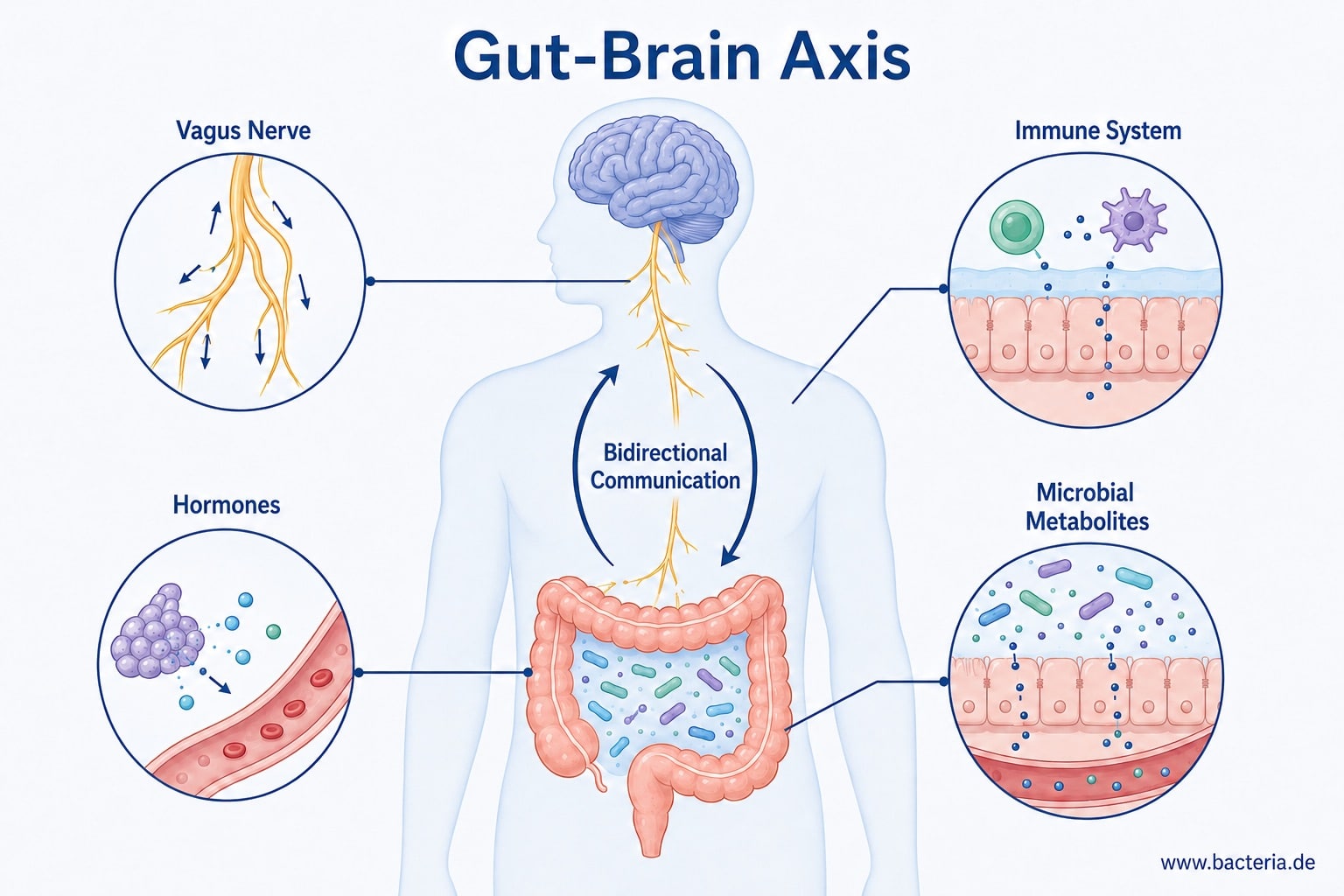
Even though the vagus nerve has many other important functions, this illustrates just how much information is transmitted from the internal organs to the brain. The gut microbiome can have a significant influence on the brain and, consequently, on our mental state.
Furthermore, the existence of a distinct brain microbiome is currently being debated, which would be a scientific sensation, since the brain is generally considered sterile. Although this is still considered speculative—since the bacterial traces found could also be due to contamination —it cannot be ruled out.
The widespread belief that serotonin —which is produced largely in the gut—also reaches the brain and influences mood there is incorrect. In fact, serotonin cannot cross the blood-brain barrier. Its precursor, the essential amino acid tryptophan—which human cells cannot produce—can, however, cross the barrier and be used in the brain to produce serotonin. The gut microbiome influences tryptophan metabolism and, consequently, its availability in the blood.
Through numerous communication pathways, the gut microbiome can indeed influence processes in the brain. These include microglia—the brain’s immune cells—as well as the formation, stability, and permeability of the blood-brain barrier, and neuronal excitability and neuroplasticity.
Thus, through the gut-brain axis, the gut microbiome has a powerful tool for altering brain function and, consequently, behavior.
Conversely, the brain can also influence the gut. This is particularly evident in response to stress. Through the autonomic nervous system and the HPA axis, factors such as gut motility, secretion, immune responses, and the intestinal barrier can be altered. This affects the gut microbiome and, in turn, can lead to increased stress in the brain via the communication pathways described above. The interaction between the gut and the brain is therefore not a one-way street, but rather a complex feedback system.
Any behavioral changes triggered by FMT would therefore have to be mediated through this gut-brain axis .
What do animal studies say about this?
There have been a number of animal studies in which gut microbiota have been transferred between animals or from humans to animals. These studies support the scientific hypothesis that changes in behavior could be triggered by a foreign microbiome.
In 2011, a research group transferred the gut microbiota between two strains of mice that differed significantly in their exploratory behavior. The result was astonishing: germ-free mice that received the microbiome of the more exploratory strain became more curious. Conversely, mice that received the microbiota from the more reserved strain became less curious. In addition, a change in the concentration of BDNF was measured in the hippocampus. BDNF is an important factor in neural plasticity.
In 2016, an Irish research group took things a step further. The scientists transplanted the gut microbiota of people with major depression into rats. Before doing so, the researchers had significantly reduced the animals’ original microbiota. The recipient animals subsequently developed depression-associated and anxiety-like behaviors. In particular, their response to pleasant stimuli was diminished after the transfer. Of course, the rats were not depressed in the human sense. However, the mental state of the human donors appeared to be linked to a microbiota whose transfer to another mammal induced altered behavior.
And in 2024, another astonishing discovery was made. Once again, during a fecal transplant, the gut microbiome of people with social anxiety disorder (SAD) was transferred to mice. The mice’s microbiota had also been significantly depleted by antibiotics beforehand.
The results were remarkable. The mice did not become more anxious in general, nor did their normal social behavior change. The difference was evident specifically in social fear. In a social fear conditioning test, the animals first learned to associate a social encounter with an aversive stimulus—that is, a stimulus that is perceived as unpleasant and avoided. The researchers then examined how quickly the mice were able to overcome this learned fear. Mice with the microbiota of SAD patients retained their social fear significantly longer than mice that had received the microbiota of healthy people.
And that is precisely what was remarkable about this study: it did not simply produce an animal with nonspecific anxiety. The transplanted microbiota very specifically influenced a behavioral dimension that is also characteristic of the human donors’ condition: social anxiety.
Direct changes in the brain were also found in these mice. In a region of the brain involved in, among other things, fear and social behavior, the researchers found fewer oxytocin-containing neurons. In addition, other genes in the oxytocin and vasopressin systems were altered. This study is thus among the most compelling experimental works supporting the core idea of “Alter Ego.”
There are other animal studies in which, for example, antisocial or depression-like behavior was triggered by the microbiota. It has also been shown that the microbiome of people with autism spectrum disorder, when transferred to germ-free mice, could induce changes in social interaction, communication, and stereotypical behavior. This does not mean that autism was transmitted. However, the microbiome was able to make a causal contribution to the manifestation of certain behaviors.
Even the microbiota of untreated individuals with schizophrenia triggered hyperactivity as well as impairments in learning and memory in mice treated with antibiotics. In addition, measurable biochemical changes were observed in the animals’ brains following fecal microbiota transplantation .
All of these animal experiments demonstrate in a striking way that the transfer of a microbial community can induce changes in complex behaviors. Such effects have now been observed in a wide variety of animal models.
This does not mean that a personality was transferred, but rather that individual behaviors or dimensions of behavior were influenced in each case.
What do human studies show?
It may not come as a surprise that there are hardly any human studies on this topic. Experiments designed to specifically investigate whether a donor’s behavioral traits can be transferred to another person are virtually impossible to conduct for ethical reasons. This demonstrates once again that animal testing cannot be entirely avoided when such complex questions are to be investigated.
It is essential in human studies that, ideally , double-blind, placebo-controlled trials be conducted to minimize bias as much as possible.
"Placebo" does not mean that nothing happens. Expectations and other psychological processes can actually bring about measurable changes . The body reacts and responds to the mind’s expectations. However, not every improvement achieved in a placebo group is automatically a placebo effect. The natural course of a disease and other factors can also play a role.
The only thing that matters in such studies is whether the treatment under investigation produces an additional and measurable effect when directly compared with a placebo .
One of the most important studies on this topic was published in 2026. Patients with major depression were given escitalopram along with either FMT capsules from healthy donors or a placebo. Escitalopram is an antidepressant belonging to the class of selective serotonin reuptake inhibitors. It increases the concentration of the neurotransmitter serotonin in the brain by inhibiting its reuptake into nerve cells.
After just two weeks, depressive symptoms had decreased more significantly in the FMT group than in the placebo group, and this difference was still evident after eight weeks. The remission rate—that is, the proportion of patients whose depressive symptoms had largely subsided—did not differ significantly, however.
In addition—and this was particularly exciting— changes in metabolism were measured. Donor bacteria colonized the recipients’ intestines, bile acids changed, and inflammatory signaling pathways were affected. The change in the microbiome was thus evident not only in clinically assessed depression scores but also in objectively measurable biological changes.
An interesting counterpoint to this was provided by a study, also published in 2026, involving patients who suffered from bipolar disorder and were currently in a depressive phase. One group received an FMT from a healthy donor, while another group had their own microbiota reintroduced. In both groups, depression scores improved significantly and to nearly the same extent.
It was noteworthy that the microbiome of the recipients of the donor FMT clearly shifted toward that of the healthy donor. Nevertheless, they did not show greater clinical improvement compared to the group that had received their own microbiome back. Expectation or placebo effects may also have played a role in this.
One of the first groundbreaking studies on this topic was conducted as early as 2017. At that time , children with autism spectrum disorder and gastrointestinal symptoms received what is known as microbiota transfer therapy, which consisted of antibiotic treatment, bowel cleansing, and the subsequent transfer of healthy microbiota. The first two steps were intended to give the new microbiota a chance to establish itself. Both gastrointestinal symptoms and autism-related symptoms improved, in some cases significantly.
However, the problem with this study was that it was an open-label study and did not include a placebo group.
In 2024, a much larger randomized, double-blind, placebo-controlled study involving 103 children was conducted.
This showed that some parameters of social behavior improved, though this was true for both the FMT and placebo groups. This, too, may point to significant placebo effects or other endogenous effects triggered by the study. However, the FMT group performed better on certain secondary measures of social behavior.
Although human studies have not yet shown that certain donor characteristics can be transmitted through the microbiota, they do show that a targeted modification of the gut microbiome can influence psychological and behavioral parameters.
In addition to the placebo effect, another factor may play an important role—one that could be particularly interesting for “Alter Ego”: the nocebo effect.
While positive expectations can trigger a placebo effect in patients, negative expectations can have exactly the opposite effect. They can exacerbate existing symptoms and cause new ones to appear. This effect is well known in medicine.
For example, studies involving cancer patients show that negative expectations can influence the perception of side effects. In one study, simply informing patients in advance about the nocebo effect led to better tolerance of chemotherapy.
In 1942, the physiologist Walter Cannon described historical accounts of so-called“voodoo deaths”among indigenous tribes, in which people died after being cursed or subjected to hexes. Cannon hypothesized that extreme fear and the resulting physiological stress response might have been responsible for these deaths.
Although the nocebo effect can be measured just as easily as the placebo effect, it is difficult to distinguish its contribution to a specific change in a person from natural fluctuations, the course of a disease, and other influences. This is precisely why they are two of the most interesting forces that play a role in human health.
And it is precisely this nocebo effect that could be decisive in Simon’s transformation. The more intensely he focuses on his new and unfamiliar microbiome, and the greater his fear becomes that the personality of a stranger might have been transferred to him, the stronger the nocebo effect could be.
This means there are suddenly two possible explanations for Simon’s change in behavior. The altered microbiome could indeed be influencing his behavior via the gut-brain axis. At the same time, the negative expectation of being, so to speak, at the mercy of the stranger’s microbiome could be influencing the protagonist’s behavior.
Can something really be “transmitted” from the donor?
After reviewing the animal and human studies, the key question that remains is whether anything can actually be transmitted from the donor.
In fact, during a fecal microbiota transplant, viruses, bacteriophages, and fungi are transferred along with the bacteria. And with them come new microbial genes, new metabolic capabilities, and thus the ability to produce other microbial metabolites in the recipient’s body.
You can think of it this way: one part of an ecosystem invades another ecosystem. So it’s not like an organ transplant, where a liver, a kidney, or even a heart is transplanted; rather, it’s as if many residents of one city were being relocated to another city.
And then, ultimately, the question is: What do these inhabitants of the old city do in the new city? The donor’s bacteria suddenly find themselves in a new environment and , if they want to stay there, must overcome colonization resistance. This might seem straightforward in the case of a C. difficile infection, since much of the old microbiota appears to have disappeared. But that is not the case.
The microbiota of a sick person consists of more than just C. difficile. Of course, there are numerous other bacteria as well .
The previous antibiotic treatments have, however, significantly weakened the colonization resistance of the entire microbial ecosystem. This effectively opens the door for the new inhabitants, who can now attempt to occupy spaces that would normally already be taken.
The question that arises here is to what extent these new bacteria can colonize these sites and how long they can survive there. For example, one study demonstrated that donor strains were still present in the recipients’ intestines up to five years after the actual FMT. FMT is therefore not a short-term procedure; rather, a person actually carries a part of another person’s microbial ecosystem within them for years.
This is indeed an astonishing observation that made a deep and lasting impression on Simon in the book *Alter Ego*. Nevertheless, the recipient does not, of course, become a microbial clone of the donor, just as the inhabitants of the old city do not simply drive out the inhabitants of the new city and turn the new city into the old city. A new, mixed society emerges.
Why is that? The donor’s bacteria do not encounter a completely empty environment, but rather an existing microbiome. They encounter a recipient with different genetics, a different immune system, and a different diet. The recipient may be taking certain medications, have a different gut physiology, and, fundamentally, live in an environment that differs from that of the donor. As a result, some new bacteria may thrive while others do not.
In principle, this transmission of bacteria is not much different from what happens in everyday life anyway. Through contact with the environment, with other people, with plants, with animals, and even through breathing, new microorganisms are constantly entering our bodies. Of course, they face challenges due to resistance to colonization, but the entry of foreign bacteria into our bodies is a completely normal process in everyday life.
In contrast, FMT is distinguished by the enormous quantity, composition, and targeted introduction of a complex microbial community into the gut.
In FMT, however, the recipient's microbiome does not become the donor's microbiome; rather, a new ecosystem emerges from the combination of the two microbial ecosystems.
From a scientific perspective, the question now arises: Can a phenotype even be transmitted via the microbiota?
A phenotype is the totality of an organism's observable or measurable characteristics. These include not only physical traits, but also physiological characteristics and behaviors.
At least for certain behavioral phenotypes, this question can be answered in the affirmative based on animal studies. For example, it has been possible to reduce aggressive behavior in hamsters, influence social fear, or induce depression-like behavior. In humans, initial studies also show changes in psychological parameters; however, the transfer of a donor phenotype has not yet been demonstrated in this context.
But can a trait actually be transferred? Was it really the donor’s anxiety that was transferred in the animal experiments, or were microorganisms transferred instead, whose metabolism induces a state in the recipient that makes anxious behavior more likely?
If I have two rooms and replace the dimmer switch in one of them so that the lighting in that room is dimmer afterward, it is not the darkness that is transferred, but rather the mechanism that controls the brightness that has changed.
The same is true for the transmission of the microbiome: Here, the brain’s regulators— the “dimmers” in our illustration—are influenced, which in turn alters mechanisms that can promote anxiety-related behavior.
However, a personality transfer—the kind Simon fears—is on an entirely different scale. In that case, a person’s entire personality would be transferred via the microbiome.
Human personality arises from a complex interplay of genetics, brain development, learning, memory, experience, the social environment, and biological factors such as hormones and the microbiome.
So it is possible that changes in the microbiome influence behavior, but so far there is no evidence whatsoever that the donor’s personality is embedded in the microbiome. Of course, there is even less evidence to suggest that memories, knowledge, or identity can be stored microbially and then transferred.
To be fair, it must be said that the novel does not claim this at all and thus stays well within the bounds of scientific plausibility. Simon is afraid that the donor's personality has been transferred to him.
However, there is a very big difference between Simon's fear and the claim that the donor's personality was actually transferred!
How well does the novel engage with academia?
This ultimately leads to the crucial question of how well the novel captures the world of science. The animal and human experiments described above confirm the author's excellent research.
He was tempted to create a Frankenstein-like monster and thereby commit a form of literary exaggeration that, while permissible in literature, would have carried the story far away from science. That was precisely what the author apparently wanted to avoid.
There are currently no scientific studies in humans indicating that aggression and other behaviors can be transmitted through a fecal transplant to the extent depicted in the novel. Such experiments are also hardly conceivable for ethical reasons. It has been shown, however, that certain human traits can be transmitted to animals. However, it remains unclear to what extent such transfers could occur from person to person.
But how far has science actually come so far? Even after ten to twenty years of research, the entire field of microbiome research is still in its infancy. While it is possible to study entire microbial communities—albeit with the known methodological biases—at the species level and, in some cases, at the strain level, However, the exact quantities and interactions among them cannot be analyzed using standard sequencing methods. Furthermore, in most cases, samples are limited to stool samples rather than tissue samples, which would be necessary to incorporate the localization of microbial groups into the analysis. Furthermore, while multi-omics analyses are a good approach, they do not reveal which bacteria produce which substances under what conditions, substances that are then further utilized by other bacteria through cross-feeding.
A great deal of data is generated these days. But it doesn't paint a convincing overall picture .
But in reality, we are dealing with thousands of different species of bacteria that colonize the human gut, with each person harboring hundreds of them. And they exist in unimaginable numbers. They communicate, they interact, and no one really knows how far these interactions actually extend.
Nevertheless, to conclude, we should make a critical distinction here between what is certain, well-documented, plausible, or unsubstantiated.
FMT Treatment for C. difficile
This is considered a fact.
Studies show treatment success rates of up to 91% with repeated treatment. Fecal microbiota transplantation can save lives. Rapid physical recovery, even after a single dose, has also been documented.
Can foreign bacterial species and their strains establish themselves in the recipient over the long term?
Saved.
Studies show that even after five years, a large proportion of the strains persisted. Once the strains have successfully established themselves, they become part of the new microbial ecosystem and , consequently, part of its resistance to colonization. However, a complete copy of the donor microbiome does not emerge, as some recipient strains remain, numerous new donor strains become established, and new strains continue to be introduced from the environment. A new microbial hybrid system emerges .
Does the donor's microbiome cause metabolic and immunological changes in the recipient?
Saved.
This has been demonstrated by both animal and human studies. Each newly established bacterial strain brings its own set of genes—and thus new metabolic capabilities—into the recipient’s microbial ecosystem.
Effects on the gut-brain axis?
Well-documented.
Bacteria that colonize the gut can influence the gut-brain axis. This has been demonstrated in animal studies, and clinical trials in humans are providing initial evidence of this.
Change in the recipient's mood
That makes sense.
There is supporting evidence from animal studies as well as preliminary data from human medical research. The gut-brain axis can have precisely this effect, as studies of patients with depression show. However, only small-scale studies have been conducted so far.
A New Fascination with Microbiology
Plausible, but can be explained independently of FMT.
No animal or human data are required for this. From a psychological perspective, a key event can lead to the development and change of personal interests.
Wandering Around at Night
Plausible as a psychological development, but not specifically substantiated in relation to FMT.
This behavior has not been directly examined in studies. Both physical and psychological changes can lead to sleep deprivation and a literal fear of sleep, which can result in insomnia. This is compensated for by activities that further disrupt the already disturbed sleep-wake cycle. This can set off a vicious cycle.
Aggression
Plausible in animal models, but unproven in humans.
Aggressive behavior can be a result of sleep deprivation. Animal models show that FMT can also influence aggressive behavior.
There are no studies on this in humans.
However, since “Alter Ego” does not directly attribute this to the FMT but leaves it up to the reader’s interpretation , this characteristic is not unusual in this context.
Transfer of the donor's characteristics or identity
Unsubstantiated.
Simon suspects exactly that, and the novel—without giving away the plot at this point—explores this theory in a fascinating way.
From a scientific perspective, microorganisms —and with them, functional and metabolic capabilities—are transmitted. There is absolutely no evidence that personality or identity is transmitted.
The novel therefore follows a clear and coherent narrative arc and a dramatic structure that remains closely tied to science. Whether Simon was actually changed by the new microbiome or whether his almost manic preoccupation with microbiology and the idea of carrying another person’s personality within himself led to his behavioral changes remains the author’s secret and is left entirely to the reader’s imagination.
That is precisely what sets good literature apart: not every detail is explained, but the reader is allowed to draw their own conclusions.
Conclusion
The book *Alter Ego* takes up a fascinating scientific and medical concept and translates it into literature. The danger with works of fiction that deal with scientific facts often lies in literary exaggeration. This is possible in and of itself, since in literature, anything goes—but the story would thereby lose its claim to scientific plausibility.
That is exactly what does not happen in this book, because it does not presume to stand above science. Quite the contrary. Throughout the book, the author’s humility in the face of the complexity of microbial networks is palpable. What is appealing about it is that he does not even attempt to overstep scientific boundaries .
He lets Simon go ahead of her.
Simon gradually begins to believe that the donor's personality is inside him. This approach is extremely clever. And it is creative and intelligent, because it leaves both microbiology and psychological self-suggestion open as possible explanations.
The book thus impressively demonstrates just how little science still knows about the microbiome, even though non-microbiologists may have a different impression. The author, Benedikt Gollhardt, therefore not only addresses the potential effects of a fecal transplant but also demonstrates that microbiome research is still in its infancy.
Once again, the best way to illustrate just how far we are at the beginning is with an image. If the path to a comprehensive understanding were 100 kilometers long, we’ve probably only covered 10 centimeters so far.
Not even one kilometer.
Not 100 meters.
10 centimeters.
But why?
In microbiome research, we are still far too often forced to think in two-dimensional patterns and mechanistic terms. We are trapped in a cause-and-effect mindset: If X changes, Y must happen. We break down complex ecosystems into individual activities and metabolic pathways.
Yet the interaction between trillions of bacteria, fungi, and viruses is an ecological masterpiece that goes far beyond that.
It is a comprehensive system with feedback loops and diverse interactions on multiple levels.
Most likely, after walking one kilometer along the route, we'll turn around and wonder how we could ever have assumed that 10 cm was enough to give us even a basic understanding.
This does not mean that current knowledge should not be used to successfully treat serious conditions such as recurrent C. difficile infections. But we should proceed with humility and be guided by the Socratic attitude of recognizing our own ignorance.
And we should be open to letting the wonders of microbiology surprise us anew every day.
Just like Simon did.
Would you like to dive deeper? Listen to the corresponding podcast episode.
Bibliography
Book and Publisher Information
Gollhardt, B. *Alter Ego*. Novel. Munich: Piper Verlag; 2026. 288 pages. ISBN 978-3-492-06655-6. https://www.piper.de/buecher/alter-ego-isbn-978-3-492-06655-6
Piper Verlag. Benedikt Gollhardt: Author Profile and Information on “Alter Ego.” Official publisher’s website. Accessed September 2, 2026. https://www.piper.de/buecher/alter-ego-isbn-978-3-492-06655-6
FMT, Clostridioides difficile, and microbiome-based drugs
Working Group of Scientific Medical Societies. S2k Guideline on Gastrointestinal Infections. AWMF Registry Number 021-024. Current version. Retrieved September 2, 2026. https://register.awmf.org/de/leitlinien/detail/021-024
Federal Institute for Drugs and Medical Devices. Fecal Microbiota Transplantation: Legal Classification as a Drug and Requirements in Germany. Official Risk Information. Accessed September 2, 2026. https://jahresbericht.bfarm.de/SharedDocs/Risikoinformationen/Pharmakovigilanz/DE/RI/2019/RI-FMT.html
Feuerstadt P, Louie TJ, Lashner B, et al. SER-109, an oral microbiome therapy for recurrent Clostridioides difficile infection. New England Journal of Medicine. 2022;386:220–229. DOI: 10.1056/NEJMoa2106516. https://doi.org/10.1056/NEJMoa2106516
Kao D, Roach B, Silva M, et al. Effect of oral capsule-versus-colonoscopy-delivered fecal microbiota transplantation on recurrent Clostridium difficile infection: a randomized clinical trial. JAMA. 2017;318:1985–1993. DOI: 10.1001/jama.2017.17077. https://doi.org/10.1001/jama.2017.17077
Kassam Z, Lee CH, Yuan Y, Hunt RH. Fecal microbiota transplantation for Clostridium difficile infection: systematic review and meta-analysis. American Journal of Gastroenterology. 2013;108:500–508. DOI: 10.1038/ajg.2013.59. https://doi.org/10.1038/ajg.2013.59
Khanna S, Assi M, Lee C, et al. Efficacy and safety of RBX2660 in PUNCH CD3, a phase III randomized, double-blind, placebo-controlled trial with a Bayesian primary analysis for the prevention of recurrent Clostridioides difficile infection. Drugs. 2022;82:1527–1538. DOI: 10.1007/s40265-022-01797-x. https://doi.org/10.1007/s40265-022-01797-x
Peery AF, Kelly CR, Kao D, et al. AGA Clinical Practice Guideline on Fecal Microbiota-Based Therapies for Select Gastrointestinal Diseases. Gastroenterology. 2024;166:409–434. DOI: 10.1053/j.gastro.2024.01.008. https://doi.org/10.1053/j.gastro.2024.01.008
U.S. Food and Drug Administration. REBYOTA: fecal microbiota, live-jslm. Indications and Approval Information. 2022. Accessed September 2, 2026. https://www.fda.gov/vaccines-blood-biologics/vaccines/rebyota
U.S. Food and Drug Administration. VOWST: fecal microbiota spores, live-brpk. Indications and Approval Information. 2023. Accessed September 2, 2026. https://www.fda.gov/vaccines-blood-biologics/vowst
van Nood E, Vrieze A, Nieuwdorp M, et al. Duodenal infusion of donor feces for recurrent Clostridium difficile. New England Journal of Medicine. 2013;368:407–415. DOI: 10.1056/NEJMoa1205037. https://doi.org/10.1056/NEJMoa1205037
van Prehn J, Reigadas E, Vogelzang EH, et al. European Society of Clinical Microbiology and Infectious Diseases: 2021 update on treatment guidelines for Clostridioides difficile infection in adults. Clinical Microbiology and Infection. 2021;27 Suppl 2:S1–S21. DOI: 10.1016/j.cmi.2021.09.038. https://doi.org/10.1016/j.cmi.2021.09.038
FMT Components, Engraftment, and Long-Term Persistence
Aggarwala V, Mogno I, Li Z, et al. Precise quantification of bacterial strains after fecal microbiota transplantation reveals long-term engraftment and explains outcomes. Nature Microbiology. 2021;6:1309–1318. DOI: 10.1038/s41564-021-00966-0. https://doi.org/10.1038/s41564-021-00966-0
Ianiro G, Punčochář M, Karcher N, et al. Variability in strain engraftment and predictability of microbiome composition after fecal microbiota transplantation across different diseases. Nature Medicine. 2022;28:1913–1923. DOI: 10.1038/s41591-022-01964-3. https://doi.org/10.1038/s41591-022-01964-3
Li SS, Zhu A, Benes V, et al. Long-term coexistence of donor and recipient strains after fecal microbiota transplantation. Science. 2016;352:586–589. DOI: 10.1126/science.aad8852. https://doi.org/10.1126/science.aad8852
Schmidt TSB, Li SS, Maistrenko OM, et al. Drivers and determinants of strain dynamics following fecal microbiota transplantation. Nature Medicine. 2022;28:1902–1912. DOI: 10.1038/s41591-022-01913-0. https://doi.org/10.1038/s41591-022-01913-0
Zuo SH, Wong SH, Lam K, et al. Bacteriophage transfer during fecal microbiota transplantation in Clostridium difficile infection is associated with treatment outcome. Gut. 2018;67:634–643. DOI: 10.1136/gutjnl-2017-313952. https://doi.org/10.1136/gutjnl-2017-313952
Zuo T, Wong SH, Cheung CP, et al. Gut fungal dysbiosis correlates with reduced efficacy of fecal microbiota transplantation in Clostridium difficile infection. Nature Communications. 2018;9:3663. DOI: 10.1038/s41467-018-06103-6. https://doi.org/10.1038/s41467-018-06103-6
The Microbiome-Gut-Brain Axis and Neurobiological Mechanisms
Arabi TZ, Alabdulqader AA, Sabbah BN, Ouban A. Brain-inhabiting bacteria and neurodegenerative diseases: the “brain microbiome” theory. Frontiers in Aging Neuroscience. 2023;15:1240945. DOI: 10.3389/fnagi.2023.1240945. https://doi.org/10.3389/fnagi.2023.1240945
Bonaz B, Bazin T, Pellissier S. The vagus nerve at the interface of the microbiota-gut-brain axis. Frontiers in Neuroscience. 2018;12:49. DOI: 10.3389/fnins.2018.00049. https://doi.org/10.3389/fnins.2018.00049
Braniste V, Al-Asmakh M, Kowal C, et al. The gut microbiota influences blood-brain barrier permeability in mice. Science Translational Medicine. 2014;6:263ra158. DOI: 10.1126/scitranslmed.3009759. https://doi.org/10.1126/scitranslmed.3009759
Cryan JF, O’Riordan KJ, Cowan CSM, et al. The microbiota-gut-brain axis. Physiological Reviews. 2019;99:1877–2013. DOI: 10.1152/physrev.00018.2018. https://doi.org/10.1152/physrev.00018.2018
Erny D, Hrabě de Angelis AL, Jaitin D, et al. The host microbiota constantly control the maturation and function of microglia in the CNS. Nature Neuroscience. 2015;18:965–977. DOI: 10.1038/nn.4030. https://doi.org/10.1038/nn.4030
Morais LH, Schreiber HL IV, Mazmanian SK. The gut microbiota-brain axis in behavior and brain disorders. Nature Reviews Microbiology. 2021;19:241–255. DOI: 10.1038/s41579-020-00460-0. https://doi.org/10.1038/s41579-020-00460-0
Yano JM, Yu K, Donaldson GP, et al. Indigenous bacteria from the gut microbiota regulate host serotonin biosynthesis. Cell. 2015;161:264–276. DOI: 10.1016/j.cell.2015.02.047. https://doi.org/10.1016/j.cell.2015.02.047
Animal Experiments and Behavioral Transfer
Bercik P, Denou E, Collins J, et al. The intestinal microbiota affect central levels of brain-derived neurotrophic factor and behavior in mice. Gastroenterology. 2011;141:599–609.e1–e3. DOI: 10.1053/j.gastro.2011.04.052. https://doi.org/10.1053/j.gastro.2011.04.052
Kelly JR, Borre Y, O’Brien C, et al. Transferring the blues: depression-associated gut microbiota induces neurobehavioral changes in rats. Journal of Psychiatric Research. 2016;82:109–118. DOI: 10.1016/j.jpsychires.2016.07.019. https://doi.org/10.1016/j.jpsychires.2016.07.019
Ren CC, Sylvia KE, Munley KM, et al. Photoperiod modulates the gut microbiome and aggressive behavior in Siberian hamsters. Journal of Experimental Biology. 2020;223:jeb212548. DOI: 10.1242/jeb.212548. https://doi.org/10.1242/jeb.212548
Ritz NL, Brocka M, Butler MI, et al. Gut microbiota associated with social anxiety disorder increases social fear. Proceedings of the National Academy of Sciences of the United States of America. 2024;121:e2308706120. DOI: 10.1073/pnas.2308706120. https://doi.org/10.1073/pnas.2308706120
Sharon G, Cruz NJ, Kang DW, et al. Human gut microbiota from individuals with autism spectrum disorder promote behavioral symptoms in mice. Cell. 2019;177:1600–1618.e17. DOI: 10.1016/j.cell.2019.05.004. https://doi.org/10.1016/j.cell.2019.05.004
Shor EK, Brown SP, Freeman DA. Bacteria and bellicosity: photoperiodic shifts in gut microbiota drive seasonal aggressive behavior in male Siberian hamsters. Journal of Biological Rhythms. 2022;37:296–309. DOI: 10.1177/07487304221092105. https://doi.org/10.1177/07487304221092105
Zhu F, Guo R, Wang W, et al. Transplantation of microbiota from drug-free patients with schizophrenia causes schizophrenia-like abnormal behaviors and dysregulated kynurenine metabolism in mice. Molecular Psychiatry. 2020;25:2905–2918. DOI: 10.1038/s41380-019-0475-4. https://doi.org/10.1038/s41380-019-0475-4
Human studies on psychological and behavioral parameters
Kang DW, Adams JB, Gregory AC, et al. Microbiota Transfer Therapy alters the gut ecosystem and improves gastrointestinal and autism symptoms: an open-label study. Microbiome. 2017;5:10. DOI: 10.1186/s40168-016-0225-7. https://doi.org/10.1186/s40168-016-0225-7
Li J, Wang Y, Li R, et al. Adjunctive fecal microbiota transplantation for major depressive disorder: a randomized, double-blind, placebo-controlled trial. Cell Host & Microbe. 2026;34:1367–1382.e7. DOI: 10.1016/j.chom.2026.05.017. https://doi.org/10.1016/j.chom.2026.05.017
Shekarriz S, Vigod SN, Bianco T, et al. The safety, efficacy, and feasibility of fecal microbiota transplantation in a population with bipolar disorder during depressive episodes: a pilot parallel-arm randomized controlled trial. The Canadian Journal of Psychiatry. 2026;71(9). DOI: 10.1177/07067437261420877. https://doi.org/10.1177/07067437261420877
Wan L, Wang H, Liang Y, et al. Effect of oral fecal microbiota transplantation in children with autism spectrum disorder: a randomized, double-blind, placebo-controlled trial. Clinical and Translational Medicine. 2024;14:e70006. DOI: 10.1002/ctm2.70006. https://doi.org/10.1002/ctm2.70006
Placebo and Nocebo Effects
Cannon WB. “Voodoo” Death. American Anthropologist. 1942;44:169–181. DOI: 10.1525/aa.1942.44.2.02a00010. https://doi.org/10.1525/aa.1942.44.2.02a00010
Colloca L, Miller FG. The nocebo effect and its relevance for clinical practice. Psychosomatic Medicine. 2011;73:598–603. DOI: 10.1097/PSY.0b013e3182294a50. https://doi.org/10.1097/PSY.0b013e3182294a50
Finniss DG, Kaptchuk TJ, Miller F, Benedetti F. Biological, clinical, and ethical advances in placebo effects. The Lancet. 2010;375:686–695. DOI: 10.1016/S0140-6736(09)61706-2. https://doi.org/10.1016/S0140-6736(09)61706-2
Michnevich T, Pan Y, Hendi A, et al. Preventing adverse events of chemotherapy for gastrointestinal cancer by educating patients about the nocebo effect: a randomized controlled trial. BMC Cancer. 2022;22:1008. DOI: 10.1186/s12885-022-10089-2. https://doi.org/10.1186/s12885-022-10089-2
Holobiont Concept
Bordenstein SR, Theis KR. Host biology in light of the microbiome: ten principles of holobionts and hologenomes. PLoS Biology. 2015;13:e1002226. DOI: 10.1371/journal.pbio.1002226. https://doi.org/10.1371/journal.pbio.1002226
Moran NA, Sloan DB. The hologenome concept: helpful or hollow? PLoS Biology. 2015;13:e1002311. DOI: 10.1371/journal.pbio.1002311. https://doi.org/10.1371/journal.pbio.1002311